
Hold the sand in place
Slope & Swale Erosion Control in Tampa, FL
Blankets, hydromulch and seed for the places where Tampa's summer rain moves soil.
- We come out, measure, and quote in writing at no charge
- Seed choice matched to sun, irrigation and soil
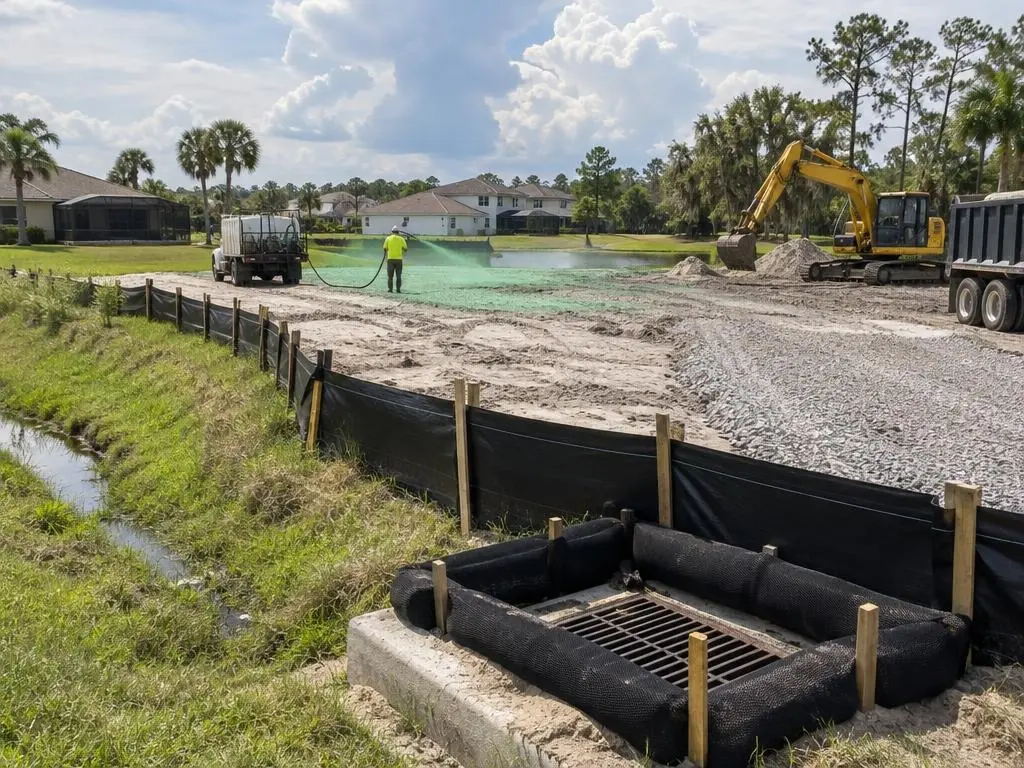
- Silt fence and inlet protection set before earthwork
Where Water Runs, Soil Follows
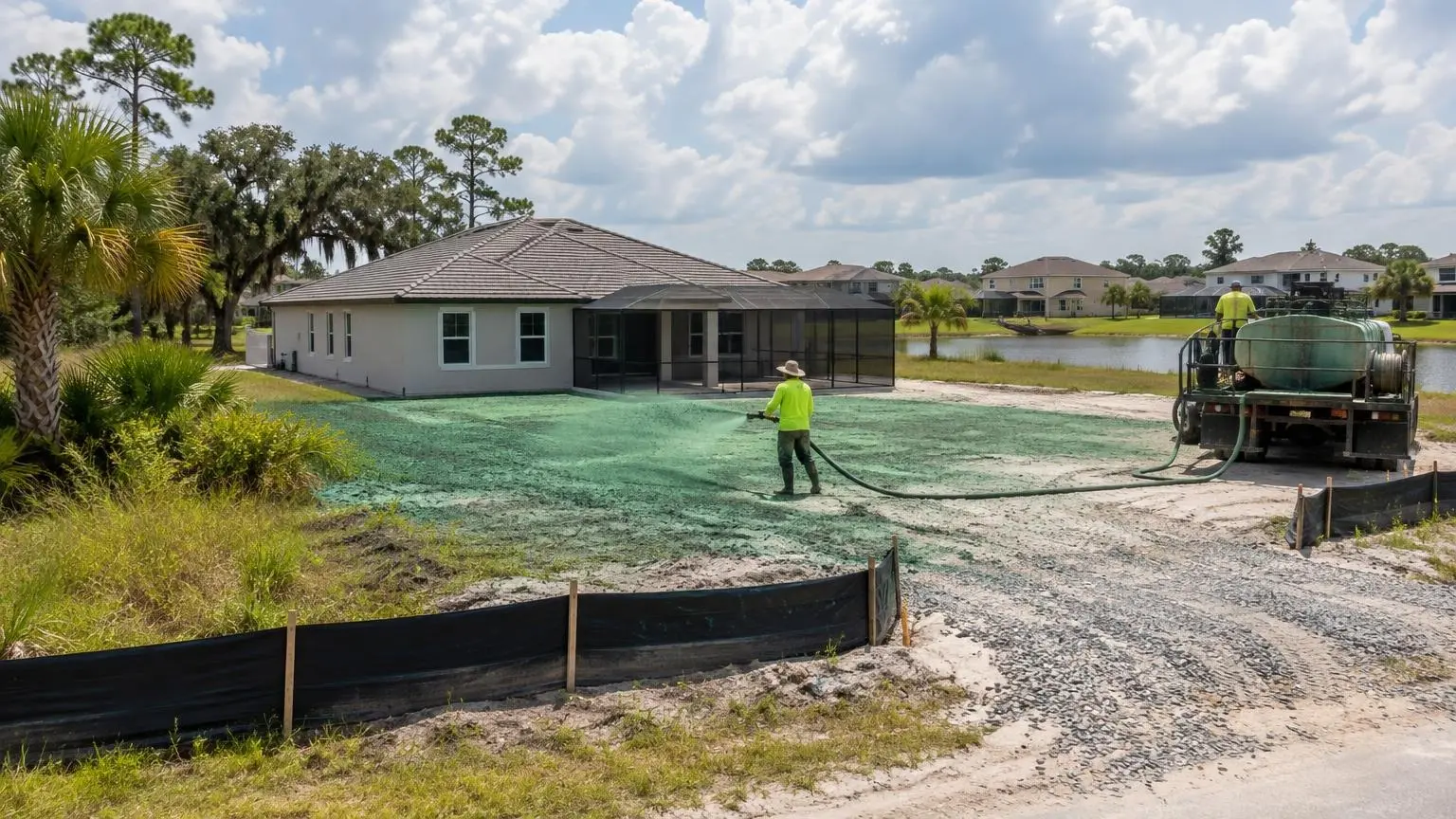
Slope and swale erosion control in Tampa is about the few places on a flat landscape where water speeds up: pond banks, drainage swales between houses, roadside ditches, berms, seawall backfill and the edges of driveways and pads. Sand has almost no cohesion, so once water concentrates, it carves rills and gullies fast. We stop that with seed plus the right cover: rolled erosion control blankets, sprayed hydromulch, or a bonded fiber matrix, chosen for how much water the spot carries and how steep it is.
Why it happens here
Tampa is low and flat, and most rain falls in summer storms. June through September average between about 6 and 9 inches a month. A swale that is dry most of the year can carry a lot of water for an hour after a thunderstorm. Myakka-type sands take in water quickly at the surface, but where the water table is high in the wet season, the ground fills up and runoff starts. Freshly graded or construction-compacted sand sheds water even faster.
Matching the treatment to the site
UF/IFAS says steep swales should be sodded or lined with an erosion-resistant material made to handle the flow in the channel, and that mounds steeper than 10 percent should be sodded rather than seeded. We take that seriously. Here is how we usually decide:
- Gentle slopes and sheet flow: hydroseed with a heavier hydromulch rate and tackifier
- Steeper banks: bonded fiber matrix, a sprayed mulch that dries into a continuous, porous mat
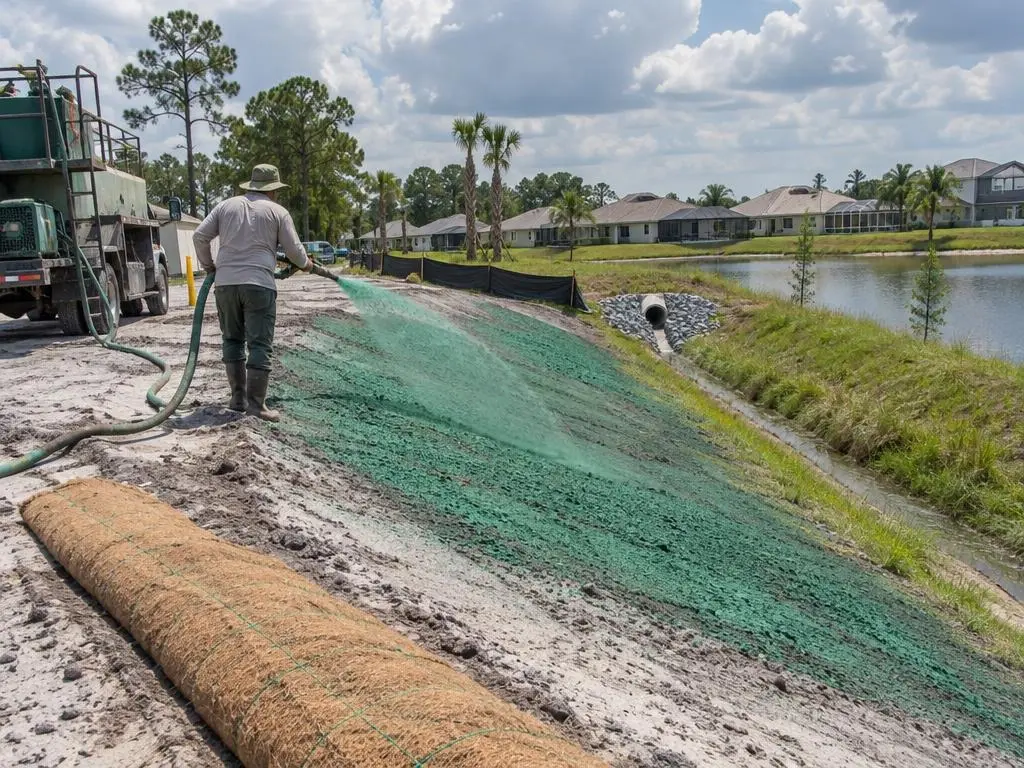
- Swales and ditch bottoms: straw, straw-coconut or coir erosion control blankets stapled over seed
- Areas with steady flow or wave action: coir blankets, or we bring in your engineer if the spot needs rock or hard armor
Erosion control blankets
Straw blankets break down in one season and suit areas with light flow while grass establishes. Straw-coconut blends and 100 percent coir last longer and hold up in channels that run hard after storms. Blankets go down over prepared, seeded soil, are trenched in at the top, overlapped downhill, and stapled so water cannot get underneath. That last part matters more than the blanket itself.
Hydromulch and bonded fiber matrix
Standard hydromulch is wood or paper fiber sprayed with seed; it protects seed from raindrop impact and keeps it damp. Bonded fiber matrix uses more fiber and a bonding agent so it forms a mat that resists runoff on steeper ground. Both can be sprayed from the road or the top of a bank, so they reach places a crew cannot easily walk.
Ponds, canals and the bay
The City of Tampa lists silt fence, inlet protection and floating turbidity barriers among its accepted erosion and sediment methods, and requires that construction keep sediment from leaving the site. On waterfront lots and pond banks, we often pair slope stabilization with silt fence at the toe so anything that moves before the grass roots is caught.
Sod versus spray on steep ground
UF/IFAS advises sodding mounds steeper than about 10 percent rather than seeding them, and warns that mowing on slopes steeper than 3:1 risks rollover. That is practical advice for homeowners. On pond banks and berms where sod is hard to place or water keeps flowing, blankets or bonded fiber matrix over seed give similar protection at lower cost. On a landscaped mound in a front yard, sod is often still the better answer, and we will say so.
Picturing a summer downpour
When we look at a slope, we try to picture it during a typical summer downpour: where water enters, how it gathers, and where it leaves. Roof runoff, a neighbor's yard, a driveway or a street gutter can all dump onto the same swale. Treating the bank without dealing with what feeds it usually means doing it twice. Sometimes the fix is a short diversion at the top, a turned downspout, or regrading a few feet of swale so water spreads out instead of cutting a channel. Those small changes cost little and make every erosion control product work better.
When to do it
The best time to stabilize a slope is before the rainy season, so the grass has roots by June. If the slope is bare in July, do not wait: blankets and bonded fiber matrix are built for exactly that situation. During hurricane season, from June 1 through November 30, we check our own work after big storms on active jobs.
Grass choice on banks
For permanent cover on banks and swales we lean toward bahiagrass. UF/IFAS describes its deep, extensive root system, which is what holds sandy soil on a slope, and says it persists in infertile sand without much water or fertilizer. Those are exactly the conditions on a pond bank nobody irrigates. Pensacola bahia, which UF notes tolerates both heat and cold well and suits roadside plantings, is a common pick for banks and ditches where looks matter less than roots. On the lowest, wettest parts of a swale, we may add a temporary cover crop so the bottom is not bare while the bahia is still coming in.
Erosion Control Methods We Use
Picked by slope, flow and how fast the area must be covered.
Hydromulch and seed
Fiber mulch slurry for gentle slopes and broad disturbed areas.
Bonded fiber matrix
A sprayed mat that resists runoff on steeper banks.
Straw erosion control blankets
Short-term cover for swales and slopes with light flow.
Straw-coconut and coir blankets
Longer-lasting blankets for channels that run hard after storms.
Pond bank and berm stabilization
Seed and blanket systems on retention pond slopes and berms.
Swale regrading and repair
Reshaping washed-out swales before re-seeding and lining them.
Published Erosion Control Prices
| Item | Published price |
|---|---|
| Hydromulch (wood fiber), 2025 DOT bid-item prices | $98 per 1,000 sq ft |
| 70/30 straw-coconut blanket, same 2025 list | $468 per 1,000 sq ft |
| All-coir blanket, same 2025 list | $532 per 1,000 sq ft |
| Straw mulch spread by hand, same 2025 list | $170 per 1,000 sq ft |
| HomeGuide's add-on for hydroseeding steep ground | +$0.05 to $0.10 per square foot |
| Bonded fiber matrix (BFM) | Quoted once we see the slope |
Published reference prices, not Tampa bids, and we found no current published figure for bonded fiber matrix. Slope length, water flow and access change each job. Your lot may land anywhere in these ranges; the paperwork we send you fixes the figure.
How We Stabilize a Slope
1. Read the water
We look at where runoff comes from, where it goes and how steep the ground is.
2. Recommend a system
Hydromulch, bonded fiber matrix, blankets or sod, explained in writing.
3. Repair and prep
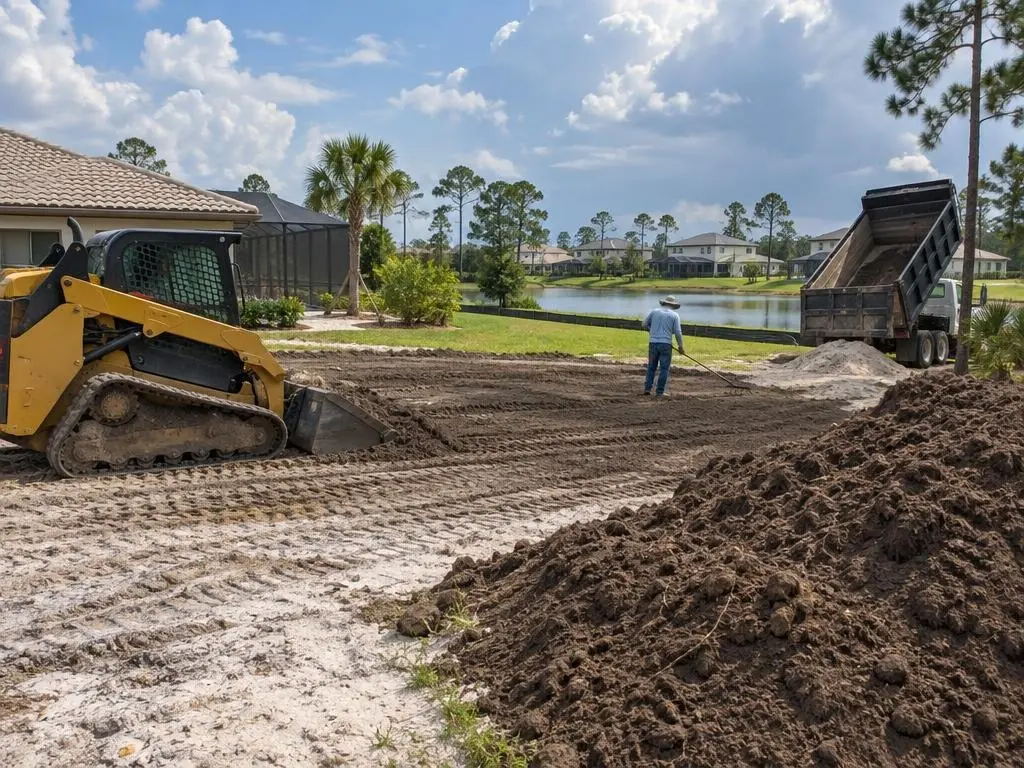
Fill rills, reshape the swale or bank, and loosen the surface.
4. Seed and cover
Seed first, then spray mulch or lay and staple blankets.
5. Check after storms
On active jobs we inspect after heavy rain and fix weak spots.
Why Choose Us for Slope & Swale Erosion Control
We follow the flow
Treatment is chosen by where water concentrates, not by what is on the truck.
Installation details
Anchor trenches, overlaps and staple patterns done to manufacturer layouts.
Honest about limits
Where flow needs rock or engineered lining, we say so.
Slope & Swale Erosion Control Questions
Hydromulch or erosion blanket: which do I need?
Hydromulch suits gentle slopes and broad areas with sheet flow. Where water concentrates, like a swale or ditch bottom, a stapled blanket holds much better. Many jobs use both.
How long do erosion control blankets last?
Straw blankets break down within about a season, while straw-coconut and coir versions last longer. The goal is for grass roots to take over before the blanket is gone.
Can you fix a washed-out swale behind my house?
Usually, yes. We reshape the swale, seed it, and line it with a blanket. If it carries water from several lots, we may also ask whether the HOA or the city has a say in the drainage.
Will grass grow through the blanket?
Yes. Seed goes down first, and the grass grows up through the open weave of the blanket.
Can hydroseeding alone stop erosion on a pond bank?
On gentle banks, often. On steeper or wave-washed banks, a blanket or bonded fiber matrix is safer until roots form.
Slope & Swale Erosion Control Service Areas
- Hydroseeding in Tampa, FL
- Hydroseeding in Brandon, FL
- Hydroseeding in Riverview, FL
- Hydroseeding in Valrico, FL
- Hydroseeding in FishHawk, FL
- Hydroseeding in Lithia, FL
- Hydroseeding in Plant City, FL
- Hydroseeding in Temple Terrace, FL
- Hydroseeding in Thonotosassa, FL
- Hydroseeding in Seffner, FL
- Hydroseeding in Apollo Beach, FL
- Hydroseeding in Ruskin, FL
- Hydroseeding in Sun City Center, FL
- Hydroseeding in Wesley Chapel, FL
- Hydroseeding in Land O' Lakes, FL
- Hydroseeding in Zephyrhills, FL
- Hydroseeding in New Port Richey, FL
- Hydroseeding in St. Petersburg, FL
- Hydroseeding in Clearwater, FL
- Hydroseeding in Largo, FL
- Hydroseeding in Oldsmar, FL
- Hydroseeding in Safety Harbor, FL
- Hydroseeding in Tarpon Springs, FL
Get a Slope & Swale Erosion Control Estimate
Free slope and swale visits across the Tampa area.